Wednesday, 15 July 2015

Tuesday, 14 July 2015
The Haus of the Wannsee Conference and Gleis 17 (July 14)
Today we had the opportunity to explore several historical sights in Berlin, and were encouraged to reflect on our own thoughts and expand our knowledge. Our lengthy day began at the location of the Wannsee Conference, the very house where the “Final Solution” was planned. We trekked through the rain to the house on the outskirts of Berlin, and our learning began.
We were given a tour of the exhibition, and provided with the history of events that took place and those who were there at the time. I found myself intrigued by this history. I was able to expand my earlier knowledge of this meeting to include exactly who was there, why they were there, and what happened.
A particularly fascinating part for myself was when looking at a quote from Katrin Himmler, Heinrich Himmler’s great-niece:
“When I was fifteen, one of my classmates asked me in the history lesson whether I was in fact related ‘to that Himmler’. I said yes with a lump in my throat. It went so quiet in the classroom you could hear a pin drop. They were all alert and curious. But the teacher became nervous and carried on as if nothing had happened. She missed the chance to make us understand just what continues to link us, the descendants, with these ‘old stories’.”
This quote stood out for me because I was shocked that she was so open about the matter. She encouraged others to learn of the events that occurred, so they may not happen again. She is spreading the message. Overall, this experience was very interesting.
 |
| Exterior view of the Haus of the Wannsee Conference |
The next stop in our day was a very moving and emotional sight. The Gleis 17 Memorial was where we stopped, and we were told we could walk around and explore the memorial site. As we observed, many of us began to notice specific details. We soon realized that there were numbers and words inscribed on the platforms, and that they held a significance that shocked many of us. The numbers were dates, a number of people, and the word ‘Juden’, followed by the name of a concentration camp. They represented the number of Jews that were sent to a specific concentration camp on a specific day. Shortly after we finished exploring, we gathered to reflect on what we had seen. I, myself, had been shocked at what I was witnessing, and I was somewhat saddened. This was a popular opinion among the majority of the group. I believe this memorial was vital for us to visit, as it truly helped put an image to what we have been learning in our courses.
~ Riley C.
 |
Flowers and candles at the Gleis 17 Memorial site
|
 |
| Inscriptions on the platform of the tracks at the Gleis 17 Memorial site |
Monday, 13 July 2015
July 13 - Berlin
Our first full day in Berlin began with a group visit to The Topography of Terror. This documentation centre sits on the land where the Headquarters for the Secret State Police and the Reich Security Main Office were located during the time of the Third Reich. Today, the installation presents information on perpetrator’s perspective, allowing us to struggle with how the Nazis rose to power, and what made them so intriguing to so many people. The Museum also asks visitors to take a look at our own assumptions, and challenges us to see how easily hate can creep into our own lives. Students also visited the outdoor installation, against the backdrop of the Berlin Wall. Beyond the wall is Germany’s current Ministry of Finance, which housed the Ministry of Aviation while the Nazis were in power.
Students began to make connections in their learning, documenting their witness through photography, journalling, and conversation. They began to tackle difficult realities such as the fact that most high ranking Nazi officials were highly educated (some with two doctorate degrees). Others commented on how what we learn at home influences our worldview, as many Nazis heard stories from returning fathers who had fought in WW1, and were disgruntled with the idea that Germany was blamed for the entire war. Still other students tied their experience moving through Topography of Terror to the fiction and non-fiction texts they have been reading in their English courses, picking up on conceptual representations found throughout the exhibition.
Our afternoon directly connected to the morning, but looked at how we remember victim groups. We visited three memorials that have been set up within Berlin. First, students walked through the varied concrete blocks that form the Memorial to the Murdered Jews of Europe. In our debrief, students were asked to decipher meaning in their experience; their connections were profound: It was a dizzying experience; It was lonely, and I found myself unable to spot my friends in the maze, connecting to family members who were separated from each other; the blocks are similar just as the Jews were made to look the same (Jews having to wear yellow stars to identify themselves as per the Nuremberg Laws, and having to shave their heads in concentration camps).
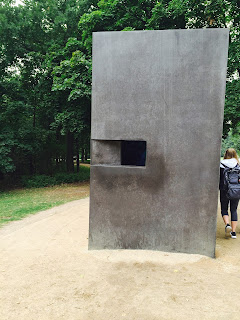
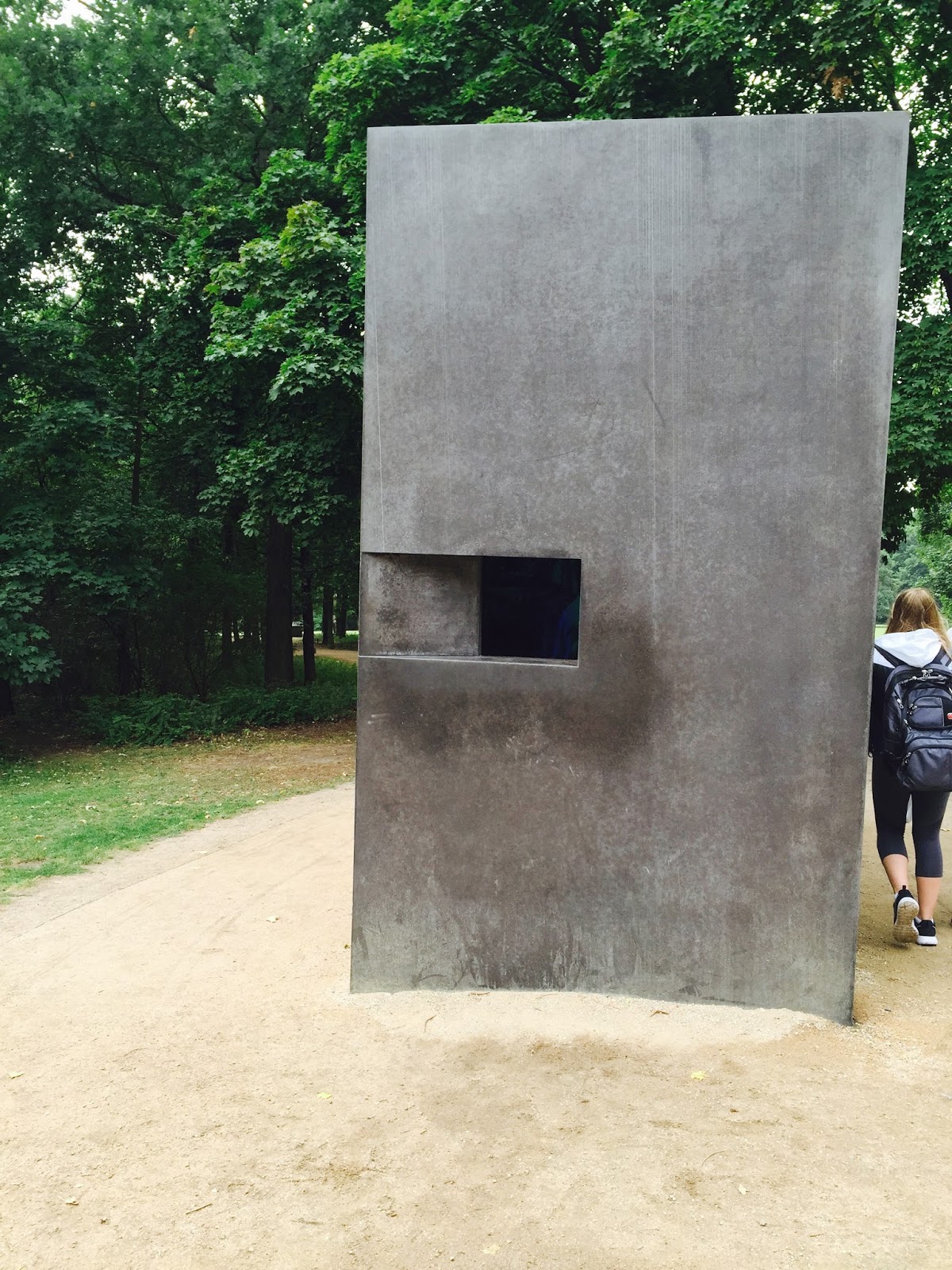
Across the street in the Tiergarten, students encountered the Memorial to the Homosexuals Persecuted Under the National Socialist Regime. After viewing the memorial we met in community to address our own reactions and compare representations of memoriam. Thus began a rich and important dialogue of understanding our own bias and prejudices, figuring out our Church teachings around homosexuality, and acknowledging that our identity is multifaceted (i.e. we are not solely defined by our sexuality, our religion, our race, etc.). Our final memorial, in the pouring rain, was our first visit to the Memorial to the Sinti and Roma of Europe Murdered Under the National Socialist Regime. This powerful installation will be further discussed in community again.


Today I witnessed The Memorial To The Murdered Jews of Europe, followed by another memorial, known as The Memorial To The Homosexuals Persecuted Under The National Socialist Regime. At the memorial for the homosexual victims, I was asked to peer into a small hole. When I looked through, I saw a short clip of two men kissing. At first, I was confused about why the artist decided to display such an intimate moment between two people, but what I learned about each memorial is that it calls us to avoid judging something upon first sight. For example, if you just came to Berlin and walked past the first memorial, you would think those cement blocks were just a maze or something fun, but I actually learned that it represents way more than that. One main thing that stood out to me was the how each of the blocks could represent how all Jews were different, and how because of anti-Semitism, Jews were seen as one race to be treated differently. Visiting the second memorial reminds us that people are slowly accepting the gay community, but that we have a far way to go. Even though we are taking small steps towards equality, homosexuals are still being discriminated against.
A message I'd like to share about my learning is to not judge someone based on assumptions. The assumptions you make at first can be completely different than the ones you have as you get to know that someone.
-Paolo A.

A message I'd like to share about my learning is to not judge someone based on assumptions. The assumptions you make at first can be completely different than the ones you have as you get to know that someone.
-Paolo A.

Sunday, 12 July 2015
Willkommen in Berlin (July 12)
Hallo aus Berlin!
After traveling across the Atlantic, we arrived in Berlin ready for our walking tour. Jacob M and Daniel P will be reflecting on their experiences learning from our two awesome guides, Carlos and Darren. Their blog posts will be available tomorrow night.


After traveling across the Atlantic, we arrived in Berlin ready for our walking tour. Jacob M and Daniel P will be reflecting on their experiences learning from our two awesome guides, Carlos and Darren. Their blog posts will be available tomorrow night.
 |
| Students waiting to check into our new home in Berlin |
 |
| Smiling students at Tegel Airport |
One of the highlights of the
first day of our field study was visiting the Brandenburg Gate (one of
Germany’s best-known landmarks, constantly changed by time). The history on
this piece of architecture is truly fascinating. I find it quite shocking how
the people of Germany were not actually allowed to approach this beautiful landmark
many years ago, unlike we were allowed to today. It is sad how many people walk
through the Gate’s openings and simply do not know its significance or the amount
of suffering that has taken place around it.
Thankfully, this trip has allowed
me to see two of the landmarks/buildings in Berlin that I have been so excited
to see. The first being the Brandenburg Gate – due to the amount of history it
has endured – and the second being the Reichstag.
Much like the Brandenburg Gate, I
was quite excited to see the Reichstag as I find the history behind it
incredibly intriguing. Looking at the Reichstag made me reflect on the
importance of my freedom as a Canadian. While doing this, I thought about the
people who looked at it nearly seventy-five years ago and wished that they had
the freedom that we students share back home today. I am
amazed by the past of the Reichstag, its significance, the decisions that have
been made there as well as what it has undergone.
Overall, the first day was
absolutely incredible. I can already tell that just by visiting a few landmarks,
the trip will be incredibly eye opening, and will allow us students to
understand what true freedom is.
-Daniel P.


During my experience with my tour
guide Carlos, my group and I were taught about many monumental sites in Berlin.
The old museum or Altes Museum stood out to me in particular because of the
history it comes with. The museum was one of seven museums, built on Museum
Island in Berlin. Notorious architect, Karl Friedrich Schinkel, who also
created many other monuments in Berlin, built the museum between 1823 and 1830.
The Altes Museum is acclaimed in neoclassicism, meaning it was built to
represent the historic Greek style. Since this building was built in Germany, the style was
confusing. I later learned it was built to represent Germany’s strength and
passion for ancient Greece considering their high power as well. I also learned
to help differentiate the building from ancient Greece, eagles were built on
top of each column, and two statues of Knights on each side of the museum were added. The experience learning about this historical monument allowed for my
discovering many things I didn’t know about German architecture and the
influence Greek culture has on it.
-Jacob M.

Bearing Witness to Max Eisen (July 7)
Max Eisen Journal Reflection
Having the opportunity to listen to Max Eisen’s testimony was truly inspiring. The amount of devastation he had experienced brought up so many emotions within me and was extremely eye opening. As I listened to Mr. Eisen speak, I was drawn to his voice because it expressed so much passion. However, this wasn’t in the form of anger or rage towards those who had inflicted extreme suffering upon him. Instead, Max took me on a journey that addressed how an event as brutal as the Holocaust should never happen again. He was so open and willing to share his story with a group of complete strangers to help benefit our knowledge of this tragic point in history. The ability he had to remain composed must have taken so much strength.
I had originally prepared to take notes while Max told his story, but surprisingly I never lifted my pencil during the entire presentation. I was drawn to his voice and couldn’t shift my focus because I feared that I would miss out on something. The way his words flowed allowed me to reflect on how I was feeling and make connections in my own life. The emphasis he placed on ideas such as the radio leaking poison are what kept me craving more and more. Something else that caught my attention was the analogy of Max’s family escaping up through the chimney. I can’t even begin to imagine how difficult it was for him to associate death with such a disturbing concept as a young boy.
There was one thing that left me with unanswered questions. Being the observant person I am, I noticed what appeared to be a tattoo imprinted on Max’s forearm. After a few moments, I realized it was the number given to him by Nazi officials at Auschwitz. How did this impact him in his everyday life? Was it simply just a reflection of his brutal past or did the permanent ink haunt him on a regular basis? Details like this made Max Eisen’s experience so real and I am honored to have been able to listen in on such an impactful story.
- Taylor B.
Thursday, 9 July 2015
Bearing Witness to Max Eisen (July 7)
Today, I had the great fortune of hearing a speech from highly respected, Max Eisen. Max, a Holocaust survivor and educator, shared his amazing and heart wrenching story to us of his experiences in Auschwitz during this time of suffering and inhumanity. Listening to this man who has such a painful yet rich history, was almost as if I had been transported into his world. His recollection of his past was so detailed in the short amount of time we got to hear him speak, but I found myself not wanting the discussion to end.
Max explained their daily allotment of food, which was 200-300 calories a day. I had known that the prisoners were starving, but I hadn’t realized that the allotment of calorie intake they received per day, and the food they ate was so specific. “Tea for breakfast, soup and water for lunch, and a thin slice of bread with butter for dinner,” he said. The Nazis had meticulously planned out everything, including the amount of food that the prisoners would receive every day to ensure starvation. It’s unbelievable to imagine that was the normal meal regime every single day, not to mention the days when food supply was low.
Mr.Eisen is such a special person today, and it is with his presence and knowledge that we can help address issues of prejudice, stereotyping, social justice, and genocide. He is someone who experienced all of these issues firsthand, and knows exactly what it’s like to be segregated and punished simply because of certain characteristics you possess. His story is something I believe all of us who listened to him will be able to carry through our lives, and use to educate others.
I was personally able to pull out lessons from his testimony. I think his passion carries him through into teaching and educating the young and old on what had happened, and he most prominently wants to spread the message that it only takes good people to do nothing, in order for evil to thrive. I would like to further my understanding and learn more about how the survivors and people were able to escape the camps, found breaks in the Nazi regime and worked to help others, just as Max did. To me, the most interesting and important part of Holocaust studies is being able to hear from people who were there, and dig deeper into their experiences. If we are educated on past events, we already hold the most powerful tool for ensuring that these events won’t repeat themselves in the future.
- Claire W.
Tuesday, 7 July 2015
Tuesday, July 7
Today students continued their study of the Holocaust, preparing for English seminars based on the different literary works being read, IDP prayer services that will bring our community together in Europe, and participating in a gallery walk showcasing the escalation of violence under the Third Reich. Our afternoon was spent keenly listening to our guest speaker, Max Eisen, who will also meet with the group in Krakow. Max shared the story of his childhood in Czechoslovakia, his family having to move to Hungary, and his eventual deportation to Auschwitz. His story was a testament to all that we have been learning about thus far. His story of resilience, and yearning to share his experience is encouraging to all of us - we too will bear witness to Max and others who suffer under repressive regimes, past and present. Max also reminded us how lucky we are to live in Canada, a democratic and free society, and our need to fight to maintain such freedom. We look forward to more time with Max while in Europe, and to walking through Auschwitz with him.


 |
| Students in IDP 4O/4U participating in a Gallery Walk |


 |
| Students in ENG 3U preparing for seminars |
Subscribe to:
Posts (Atom)